|
|
|
|
|
Beneficial Nematodes P.O. Box
1555, Ventura, CA 93002 800-248-2847
* 805-643-5407 * fax 805-643-6267 e-mail
bugnet@rinconvitova.com web
www.rinconvitova.com |
|
|
|

|
|
|
|
|
Beneficial Nematodes P.O. Box
1555, Ventura, CA 93002 800-248-2847
* 805-643-5407 * fax 805-643-6267 e-mail
bugnet@rinconvitova.com web
www.rinconvitova.com |
|
|
|
Beneficial
nematodes are microscopic worm-like organisms found naturally in soil. There
are many species--good, bad and in-between. Good nematodes kill pests in soil.
They work best when soil stays moist, killing in about 48 hours by releasing
unique bacteria inside pest larva, hence they are called infective parasitic nematodes. Several species are available
commercially in various size packages and formulations and will attack a broad
host range. The following descriptions indicate which nematode species is best for different systems and pests.
Heterorhabditis
bacteriophora (also Nemasys G) can be used in lawn and field
conditions in soils at 55º F to 86º F against:
• cucumber,
flea, scarab and Japanese beetle, strawberry root and black vine weevil,
chafer, white grub, corn root worm, billbug, Colorado potato beetle, Oriental
and Japanese beetle
• highly
motile, and "cruising" in search of host, thus valuable when the pest
is more dispersed
• more
potent, because they have a "tooth" to rupture and enter the insect's
skin
• twice as
good against white grubs compared to S. carpocapse
Heterorhabditis
megidis (Nemasys
H) is applied April-June and Aug-Nov for black vine weevil when soils are 55º F to 86º F.
Seasonally available.
Steinernema
carpocapse (also Millenium) are used in lawn, garden and orchard soils
at 55º F to 90º F at 1 billion per acre (less for caterpillars; more for
cranberry girdler, mint pests and weevils):
• fleas,
codling moth, navel orangeworm, peach tree borer, mint root borer, cranberry
girdler, cutworm, armyworm, leafminer, sod web worm, mole cricket, banana moth,
other caterpillar pests, termite, bluegrass weevil
• S.
carpocapse wait to ambush a passing host, latch on and crawl through body
openings
• S. carpocapse is the preferred species when hosts are mobile
Steinernema
feltiae (also Nemasys) are
used in media at 50º F to 86º F or as a foliar against:
• fungus gnat, shore fly, mushroom gnats, fruit fly, Western flower thrips, leafminer
• biocontrol
inhibition of some plant parasitic nematodes, particularly root-knot nematodes
• house
flies need 5-10 million nematodes per 25 sq. ft. of manure pile.
For high levels of fungus gnats, Steinernema move through rockwool, peat, sawdust or soil growing media without difficulty. They will not reproduce or stay in the growing media and must be reapplied if reinfestation occurs. Follow these steps:
·
Apply nematodes when
yellow sticky traps average over 50-75 fungus gnat adults/trap, weekly, or
while fungus gnat populations appear to be increasing.
·
If root diseases are
a problem in the crop, apply nematodes sooner to reduce the risk of disease
transmission by fungus gnat larvae.
·
Three applications
7-10 days apart are usually required. Follow product label for rates.
·
Calculate based on
actual growing area (i.e., containers or beds) not greenhouse area.
Steinernema
kraussei (also Nemasys L)
are applied June-Sept in turf at 41º F to 86º F against Japanese beetle,
European chafer, Masked chafer, Oriental beetle, and black vine weevil. 250
million will treat 5500 square feet.
Steinernema
riobrave (BioVector) are used
at soil temperatures of 50º F to 86º F or as a foliar:
• In citrus
against citrus weevil, blue green weevil, borers at 20-40,000 per square foot,
0.5 to 1 billion per acre for fuller rose beetle.
• In
turf for mole crickets (or use Steinernema scapterisci, Nematac S).
• black vine weevil and strawberry weevil at 3 billion per acre.
• competes with root knot and sting nematodes.
Quantity guidelines
Beneficial nematodes supplied by Rincon-Vitova
are used at around 1 million per 60 ft2 and 1 billion per acre, but
product labels vary. Release every three to six weeks until infestation
subsides. The warmer and more regular the watering system, the lower the
required rate. With lower rates, control declines. For example, using H.
bacteriophora against Japanese beetle grubs, after three weeks, a billion per
acre achieved 85-90% control while half that much resulted in half the control.
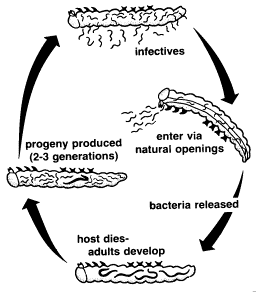
Steinernema
life cycle
From:
“Steinernematid and Heterorhabditid Nematodes”, Southern Cooperative Series Bulletin
331, AK Ag. Exp. Stn., Fayetteville, AK 72701
Spot
treatments effective for many pests
For
control of fleas, applications should be made to areas the pet frequents, such
as feeding and watering sites, beds, or shaded areas. When treating tree pests,
treat the drip line area, about one-fifth of the total acreage. For tree bark
pests, nematode solutions are injected into borer holes.
When and how to apply
Soil
temperature should be greater than 45º F to apply all species and warmer for
some. At that temperature they will live but not grow very well. When soil
reaches 60º F all species will grow and parasitize insects. Late evening or
night is ideal and never when the ground is hot and dry. Water dry soils before
applying. The best conditions are cloudy, cool weather in spring or late summer
while soil temperatures are between 60º F and 85º F. When using a sprayer, use
a course nozzle, remove screens and pressures can be set up to 300 psi. The
mixture can also be distributed through an irrigation system.
How it comes
Our 10, 25
and 50 million units come as a moist powder sealed in a small Ziploc bag. We
also carry a 7 million unit in vermiculite.
Our larger
bulk units come as water dispersible polyacrylamide gel in trays. Our bulk OMRI
listed nematodes for organic production are packed in trays of diatomaceous
earth (DE).
Directions for mixing
Place powder, gel or DE in water and let it
sit for five minutes. Then stir nematodes and carrier into a suspension in the
water so you can sprinkle or spray them on the ground. The suspended nematodes
survive about three to four hours depending on temperature and oxygen in the
water, so mix only what you will apply today. They will eventually drown in the
water.
To
illustrate in the case of a small backyard, use a quart jar and a sprinkling
can or hose-in sprayer. Mix a 10 million nematode pack in 3 cups of water in
the jar. When fully suspended, pour 1 cup into the sprinkling can or sprayer
jug. Fill the sprinkling can or sprayer jug with water. Spread or spray the
contents over approximately 13 ft2. Refill the sprinkling or
spraying container with the second cup of suspended nematodes (swirl around
before measuring), fill with water, and cover the next 13 ft2.
Finally pour the last cup of nematode suspension, dilute in the sprinkling can
or sprayer jug, and cover the last 13 ft2. The amount of water is
not important so long as it allows you to spread the total pack of 10 million
nematodes over 500 ft2.
To mix half the quantity from a pack, use
half and leave half in the plastic bag and return to refrigerator. There is a
risk that the remainder will dry out, so push the air out, seal it tight, and
don’t store long once the package is opened.
For nematodes packed in vermiculite, sprinkle the carrier
in the pots or soil surface, distributing 1 million nematodes over 50 ft2
or from 1,000 to 60,000 per 6 inch pot and water it in. Black vine weevil in
strawberries, for example, is controlled using 10,000 to 20,000 nematodes per
pot.
Agitate solution and keep soil moist
Agitate the water in the container while applying. Keep the soil moist
with light watering afterward to help the nematodes move into the soil. Avoid over-watering plants for one week after applying
nematodes as they may be washed out of the media. To check
viability, examine a drop of the suspension with a hand lens. Live nematodes
will be curved and ideally moving in the water drop. If dead, they are
straight.
Easy and safe
Nematodes are easy to use and don’t harm beneficial organisms, such as
earthworms. They don’t pollute and are harmless to us and our pets. They are
exempt from registration by EPA.
Copyright 2007 Rincon-Vitova Insectaries, Inc