|
|
|
|
|
Citrus Mealybug Parasite
Leptomastix dactylopii PO Box 1555, Ventura, CA 93002 800-248-2847 * 805-643-5407 * fax
805-643-6267 questions bugnet@rinconvitova.com orders orderdesk@rinconvitova.com www.rinconvitova.com |
|
|
|
|
|
|
|
|
Citrus Mealybug Parasite
Leptomastix dactylopii PO Box 1555, Ventura, CA 93002 800-248-2847 * 805-643-5407 * fax
805-643-6267 questions bugnet@rinconvitova.com orders orderdesk@rinconvitova.com www.rinconvitova.com |
|
|
|
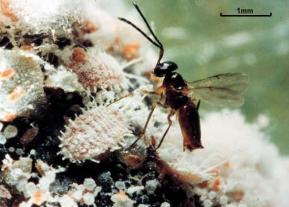
Packaging:
30ml vial contains 100 adult Leptomastix dactylopii
(Hymenoptera:Encyridae) parasitic wasps
Target: Citrus mealybug, Planococcus citri; third larval stage and
adult. Other mealybug species are not
parasitized.
Appearance: Female adults: ± 3 mm, yellow brown. Male adults:
smaller than female, hairy antennae.
Other stages: develop inside host.
Fecundity: 60-200 eggs
Introduction Rates
|
|
RATE |
ONE UNIT COVERS: |
FREQUENCY &
INTERVAL |
|
Preventive |
1/m2 |
100 m2 or
infested plants |
- |
|
Curative light (10-15 adult
and egg masses per
plant) |
5/ m2 |
20 m2 or
infested plants |
every week for at
least 3 weeks |
|
Curative heavy (20+ adults
and egg masses per plant) |
5/ m2 |
20m2 or
infested plants |
weekly along with Cryptolaemus
montrouzieri |
Introduction: Between infested leaves in the morning or in the
evening. Releases
of 200-1,200 per acre controlled citrus mealybug in citrus orchards in Sardinia
(Marras 2000)
Life cycle: About 25 days at 72°F and 18 days at 80°F. Eggs are laid inside a 3rd larval stage or adult mealybug
and hatch within 2 days. The mealybug
becomes a legless, brown and barrel-shaped mummy with 5-6 days as the wasp
larvae develops inside. After 7-8 days
more the adult chews a hole in one end of the mummy and emerges. Adults feed upon the honeydew produced by
the mealybugs and will live longer if this or an alternate source, such as
nectar, is available.
Visual effect: Look for the mummies with exit holes approximately 2
weeks after introduction!
Scouting: The key to effective control! Do a visual check of 5 lower branches per
row, and the upper third and buds on 5 plants per row. Scout weekly for preventative, twice weekly
for light and 3-4 times weekly for heavy control. Pheromone traps are available for monitoring mealybug presence at
low densities.
Pesticide compatibility: Leptomastix is susceptible to many of the pesticides that
mealybugs have developed resistance to.
Contact RVI for specific questions but generally 2-4 weeks are necessary
between pesticide application and release of beneficials.
Storage: It is not possible to store these beneficial insects after receipt! Release immediately upon receipt!
Marras, P.
2000. “Biological control of Planococcus
citri (Risso) with Leptomastix dactylopii (How.) for reducing
insecticide use in citrus production in Sardinian”
http://www.ejbiotechnology.info/feedback/proceedings/05/ortuingl.html
Produced by Syngenta Bioline