|
|
|
|
|
Encarsia
formosa Whitefly
parasite by Applied
Bio-Nomics PO Box 1555, Ventura, CA 93002 800-248-2847 * 805-643-5407 *
fax 805-643-6267 questions bugnet@rinconvitova.com orders orderdesk@rinconvitova.com web www.rinconvitova.com |
|
|
|

Target
pests
Greenhouse whitefly (Trialeurodes
vaporariorum)
Silverleaf whitefly (Bemesia
argentifolia)
Sweet potato whitefly (Bemesia
tabaci)
Description
‘Encarsia’ is a tiny parasitic wasp that parasitizes
whiteflies. It was the first biological control agent developed for use in
greenhouses.
·
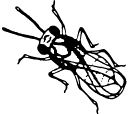
Adults are black with yellow abdomen,
less than 1 mm (1/20 inch) long (they do not sting).
·
Larval stages live entirely inside
immature whiteflies, which darken and turn black as the parasites develop
inside.
Use
as Biological Control
·
Encarsia are effective controls for
greenhouse whitefly on greenhouse cucumbers, tomatoes, peppers and poinsettias
·
They can control silverleaf/sweet
potato whitefly, but only under optimum management using high release rates.
·
Optimum conditions are temperatures
over 68° F (20° C), high light levels (7300 lux) and relative humidity 50-70%.
When daytime temperatures are less than 64° F (18°
C) Encarsia activity is sharply reduced, making them less effective.
·
Do not attempt to use Encarsia if high
whitefly populations are already established.
·
The predatory beetle Delphastus avoids
feeding on whiteflies parasitized by Encarsia, therefore it can be used with
Encarsia.
·
The parasitic wasp Eretmocerus californicus may also be used with Encarsia.
Monitoring
Tips
Check the undersides of lower leaves for parasitized
whitefly scales. They turn black (for greenhouse whitefly) or transparent brown
(for sweet potato whitefly) so are easy to tell from unparasitized scales,
which are whitish.
|
|
|
|
|
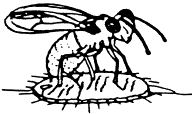
Parasite lays egg
in 2 week-old whitefly scale |
Parasite
grows inside scale for 20-25 days |
Mature parasite
emerges, lives about 10 days. |

Life
Cycle
The complete life cycle takes about 28 days at 70o F
(21o C). Temperature affects development rate; for example, larval
development takes 15 days at 77° F (25°
C) and 45 days at 15°C (59°F).
·
Encarsia populations are all female
(males sometimes occur but they are not functional).
·
Eggs are laid in 2-week-old whitefly
scales (second and third whitefly larval stages), one egg per whitefly. Most
Encarsia are female and each lays up 10 eggs per day for an average of 200
eggs.
·
Larvae develop inside the whitefly
scale for 10 days (at 20-25°C).
·
They pupate for another 10 days, then
adults emerge by chewing a hole in the top of the scale. Adults are most active
for about 10 days, although they can live up to 30 days.
In addition to parasitizing them, Encarsia kill whitefly
scales by feeding on the host directly; they also feed on whitefly honeydew.
Product
Information
Encarsia
pupae are sold glued onto cards or loose scales.
For
pupae on cards, it is important to hang the cards from lower leaves in the
shade as Encarsia tend to fly upward; avoid wetting them while watering. If
there are hanging baskets in the greenhouses, some cards must be placed on the
baskets, as well as on plants on benches.
Adults
will emerge from the pupae over a period of 1-2 weeks at 68-77o F
(20-25 °C).
Small
emergence holes in the pupae are visible using a 5-10X lens and indicate that
the parasite has emerged.
If
necessary, the Encarsia pupae can be held for up to 2 weeks at 40-50o F
(5-10o C), however the percentage of emergence will decrease with
time.
Introduction
Rates
General
Introduction Rate
·
1-10 Encarsia/m² (10 ft²) or 1-5
Encarsia/infested plant, every 1-2 weeks for at least 5 introductions, or until
80% of whitefly scales are parasitized.
In commercial greenhouses, Encarsia are usually released,
either:
·
in low numbers before pests are present
(called an inoculative release), or,
·
in higher numbers after pest
populations are established (called an inundative release).
Before
whiteflies are detected (1
m² = 10 ft²)
·
Tomato, cucumber – 1.5 Encarsia/m²,
weekly
·
Sweet pepper/egg plant – 0.5 Encarsia
/m², weekly.
After
whiteflies are established:
|
Number
of whiteflies/week counted on yellow traps |
Tomato, Pepper, Eggplant Release
rate/m2/week |
Cucumber Release
rate/m2/week |
|
1-4
|
2 |
3 |
|
5-8 |
4 |
6 |
|
over
8 |
8 |
10 |
Note: Above rates must be at least doubled for control of
silverleaf/sweet potato whitefly or if temperatures are 66o F (18°
C) or less.
Encarsia tend to remain in regions where the whitefly are
concentrated, therefore it is important to distribute them well throughout the
greenhouse:
·
For inoculative releases, spread
introductions over 40 or more release points per 10,000 ft².
·
For inundative releases, use 60 or more
release points per 10,000 ft² (1,000 m²) and place more where whiteflies are
found.
Once the percentage of parasitized scales exceeds 80%, the
number of Encarsia present should be enough to control greenhouse whitefly.
For
Best Results
·
The whitefly species in a crop must be
correctly identified to make sure it is a species that Encarsia can control and
to determine the correct release rate.
·
Eliminate whitefly from alternate plant
sources, such as weeds or previous crops, and from cuttings before Encarsia
releases begin.
·
High whitefly populations hinder
movement of the parasite as does the presence of excessive amount of honeydew.
Remove whiteflies and honeydew by spraying with water or 1% Safer’s®
insecticidal soap.
·
When de-leafing tomato plants, do not
remove leaves that have significant numbers of black (parasitized) whitefly
scales. If leaves must be pruned from plants, retain them in the greenhouse,
under the plants, until the wasps have emerged (1 to 2 weeks).
Using
Pesticides
Encarsia are extremely sensitive to insecticide residues.
Plastic covering or flooring used in greenhouses may harbor residues at levels
that are harmful to this parasite for over 6 months. If, after a month of
introducing Encarsia, whitefly parasitism is not occurring, contact supplier
for assistance.
Spreader stickers in spray applications are harmful to
Encarsia.
·
If whitefly hot spots develop, spot
spray with Safer’s soap (1% solution), weekly, directing the spray onto new
leaves to kill adult whiteflies and early stages of scale.
·
Kinoprene (Enstar®) may also
be used on ornamental crops.